Ideas

IDEAS FOR YOU TO TRY

The following section provides some IDEAS about how we CAN reduce our carbon footprint. This is not an exhaustive list, but here are some thought provoking and effective ideas that you may wish to try, for the purpose of reducing your carbon footprint, addressing climate change, preserving and enhancing nature, making a difference, AND SAVING MONEY. If you cannot find the time to read all the information provided in each section below, that's a shame, but we know you are busy, so please go to the Summary at the end of each section and try to adopt one or more of these ideas.

Highest emitting UK sector

Transport by Car, SUV & Motorbike

Domestic & international transport = 38.63% of UK emissions (excluding waste).

38.63%

UK emissions from transport - the single biggest sector

42 kg

CO₂e for one petrol car trip, Manchester → Cardiff

10 kg

CO₂e for the same trip by coach - 4× less

Quick-fire actions

Avoid short car journeys - walk, jog, cycle, scoot. Good for you AND the planet.
Join a car-share scheme. Give or get a lift.
Do you really have to be there? Use virtual meetings.
Drive smoothly - anticipate brakes, coast into queues, keep your distance.
Reduce your speed. Cuts fuel, emissions and cost - for petrol, diesel AND electric.
Keep tyres at the manufacturer's pressure. Under-inflated = more friction, more fuel, faster wear.
Remove roof boxes when not in use - cuts drag.
Have your car serviced as recommended - efficient cars emit less.
Trains and coaches let you work or rest. Driving doesn't.
EVs are NOT zero emission - 8% of UK electricity is lost in transmission, batteries have a footprint, and mining minerals has a cost. Research carefully before switching.
Hire an EV for a few days before buying to see if it fits your life.
Some UK tax subsidies still reward hybrid 'company cars' even when run on fossil fuels. Madness.

In numbers

Same journey, very different footprint

The Department for Transport publishes per-passenger CO₂e for every common mode. For a typical 2023 Manchester → Cardiff trip, the gap between a single-occupancy petrol car and a coach is more than four-fold - the same destination, the same time saved at the other end, a fraction of the emissions.
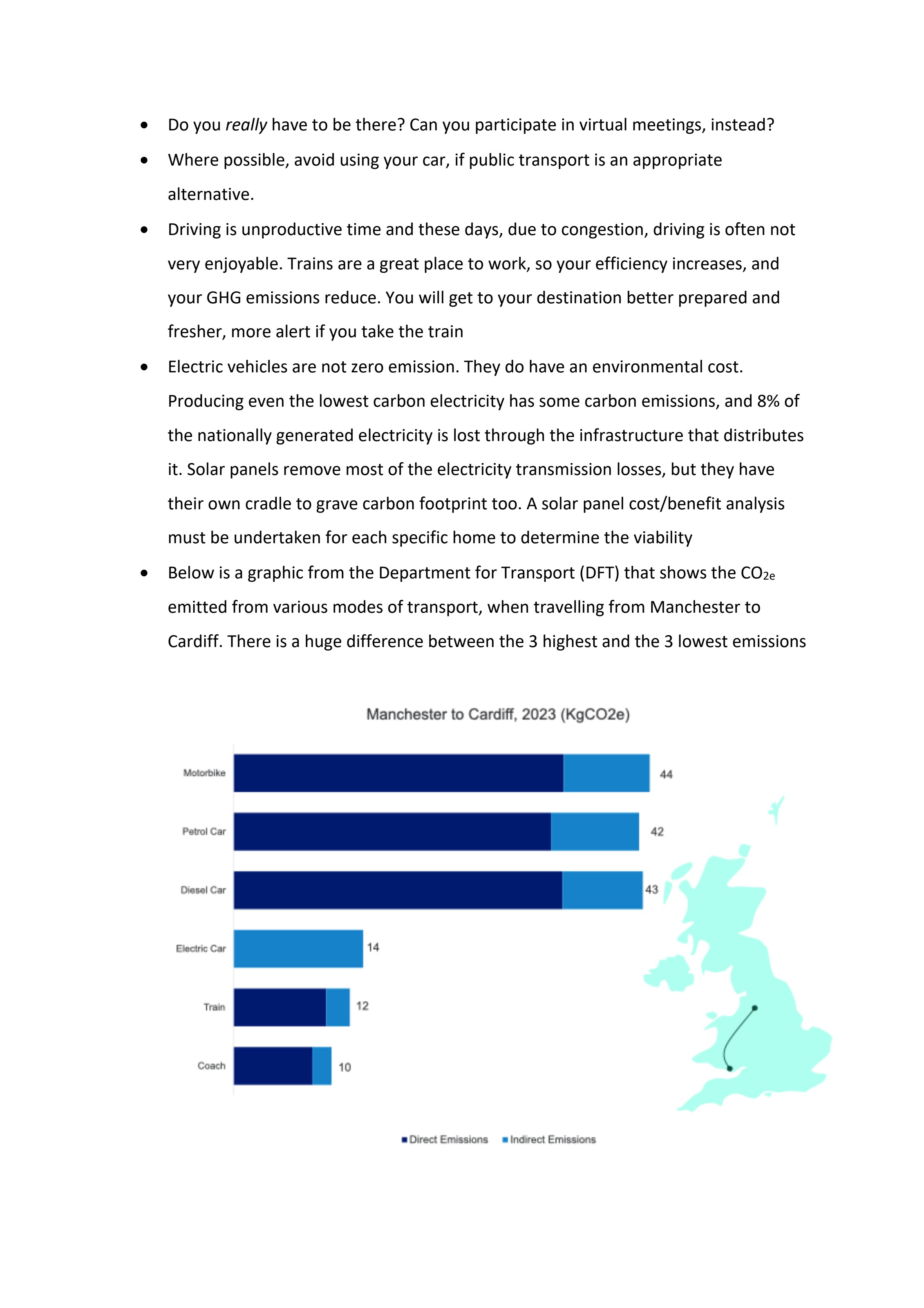
DfT chart comparing CO2e per mode of transport, Manchester to Cardiff 2023.
Manchester → Cardiff, 2023, kg CO₂e by mode. Source: UK Department for Transport.

Flights, Ferries, Coaches & Trains

Short-haul flights are disproportionately carbon-intensive per mile.

175 kg

CO₂e per passenger flying Glasgow → London

28 kg

Same journey by train - 6× lower

22 kg

Same journey by coach - 8× lower

Quick-fire actions

Not flying is one of the biggest single carbon wins you can make.
Short-haul flights have proportionally higher CO₂e per mile than long-haul.
'Sustainable aviation fuel' still produces the non-CO₂ effects (water vapour, NOx, aerosols) that warm the atmosphere.
Take a ferry as a foot passenger across the Channel, Irish Sea or North Sea. Overnight sailings are available.
Taking a car on a ferry only beats flying if the car is full and the road miles each end are short.
Use the UK coach network - leave your car at home and let someone else drive.

The picture in one chart

Trains and coaches make short-haul flights look indefensible

For UK and near-Europe trips, rail and coach almost always beat flying once airport time, baggage and transfers are added in - and at a fraction of the carbon.
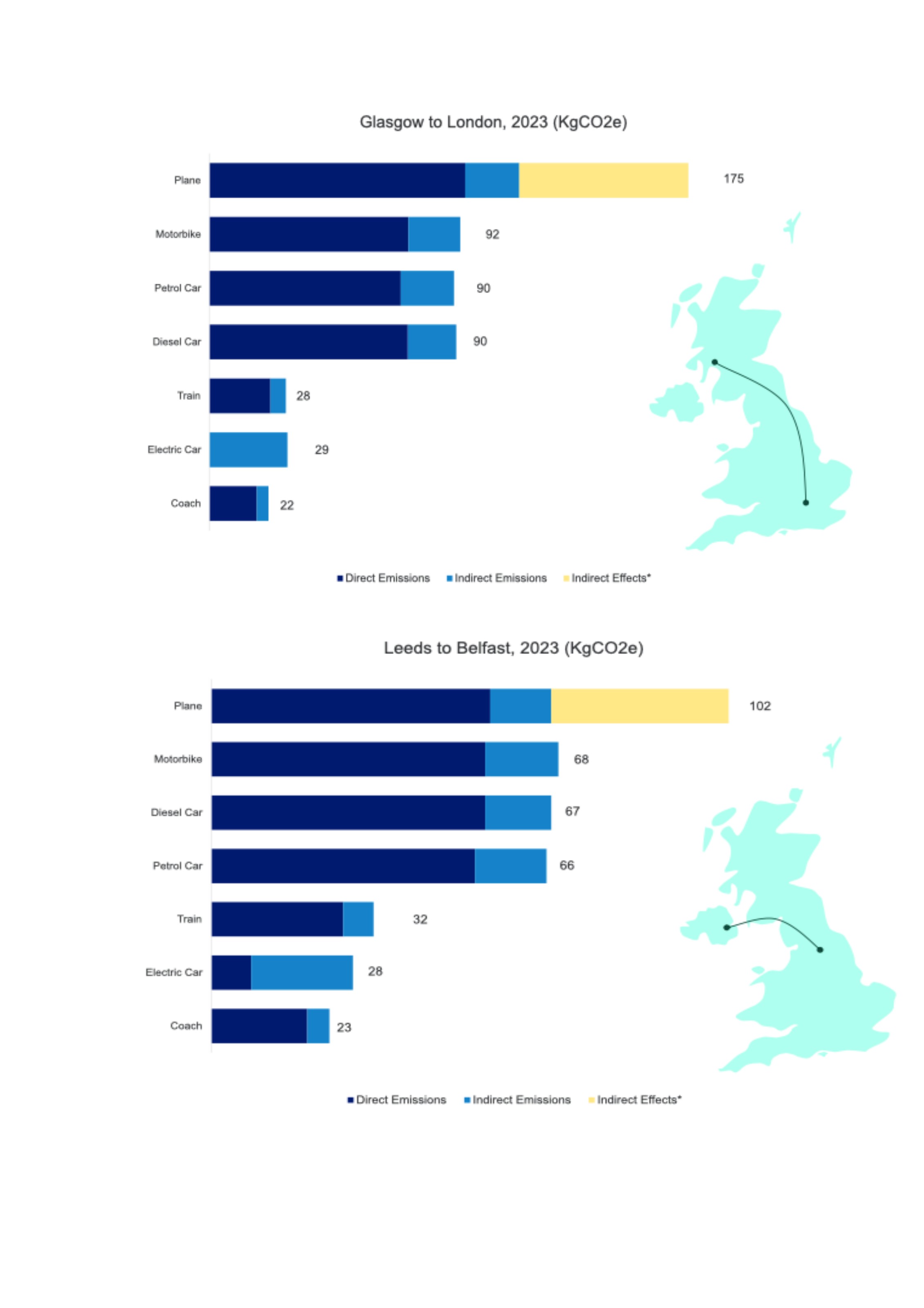
DfT charts comparing flight, train, coach and car emissions for Glasgow-London and Leeds-Belfast.
Short-haul comparisons (Glasgow → London, Leeds → Belfast, 2023). Source: UK Department for Transport.

Summary: Use cars less. Use them more efficiently. Fly less - especially short-haul. Take trains, coaches and ferries.

Buildings & product uses = 13.85% of UK GHG

In Your Home

Small daily habits compound. So does insulation.

448 TWh

Electricity used by global AI in 2025 - more than all of Saudi Arabia

24/7

Fridges and freezers run constantly - energy label matters

-1°C

On the thermostat. Layer up. Big savings.

Get a smart meter - some tariffs are cheaper with one.
Switch to a renewable energy supplier.
Reduce your dependence on AI - it's a huge hidden energy drain.
Consider solar panels - take independent advice from the Energy Saving Trust.
Turn off lights in empty rooms. Use LED bulbs.
Lower your hot water immersion temperature a few degrees.
Only boil the water you need in the kettle.
Set heating timers - don't heat an empty home.
Insulate and draught-proof. Government grants come and go - watch for inflated quotes when grants are mentioned.
Dry clothes outside or in a room - avoid tumble dryers.
Turn TVs and computers fully off, not standby.
Cut cloud storage - data centres burn serious energy. Delete old files and apps.
Outdoor lights on a PIR sensor with auto-off.
Use ECO settings. Check energy labels before buying any appliance.
Save washing-up water to wash hands later. Don't over-fill the bath.

Product Purchases

The lowest-carbon product is the one you didn't buy.

Do you really need the latest 'Must Have'?
Buy pre-owned, reconditioned, refurbished - or from a charity shop.
'Made in UK' = 50%+ of manufacturing or value-add in the UK.
'Made in Britain' logo = stricter - company registered in Britain, labour in GB/NI, substantial transformation of materials.
Check the manufacturer's ESG (Environmental, Social & Governance) credentials - upstream supply AND downstream distribution.
Look for a lifecycle environmental statement and recycling instructions.
Check warranty length and spare parts availability.
Don't buy on price alone. £80 lasting 5 yrs = £16/yr. £100 lasting 8 yrs = £12.50/yr.
Choose plant-based / natural products for personal care - they neutralise organically, not chemically.
Question the marketing of household chemicals - are they really doing what the ads claim?

Summary: Buy less. Buy British. Buy local. Buy ethical. Buy sustainable.

In Your Garden

Grow food. Compost waste. Build a wildlife ecosystem outside your window.

Grow your own food

Grow fruit and veg in grow-bags, a greenhouse or outdoors. Carrots, peas, tomatoes, cucumbers, raspberries, blueberries, apples and pears — all delicious raw and freshly washed.
Glut? Give it away, preserve, pickle, or make sauces and crumbles.
Home-grown food cuts supply-chain waste, packaging and distribution emissions.
Collect rainwater from roofs to water your crops.

Composting

Trimmings + kitchen organics + lawn clippings = nutrient and humus-rich soil enhancer.
Your compost will be full of worms - you don't get those in shop-bought compost.
Billions of beneficial bacteria build healthy soil.

How to Attract & Enjoy More Wildlife

From window boxes to hedgehogs - small changes invite a lot of life.

Flowers & lawns

Even a window box attracts insects - and where there are insects, there are birds.
Mow on a high setting. Let clover and dandelions flower for bees, butterflies, finches, sparrows and siskins.
Bee-friendly plants: Alliums, Borage, Buddleia, Poppy, Wallflower, Lavender, Sunflower, Foxglove.
Daffodils and tulips feed insects coming out of hibernation.
Wildflower plugs work better than seed in rich garden soil.
Longer grass shelters newly-fledged birds like tree sparrows from predators.

Shrubs, hedges & trees

Cotoneaster and Leylandii: a maze of cover and nest sites for small birds.
Contorted Willow, Holly and Privet: safe havens; larger ones become nest sites.
Blackthorn and Hawthorn hedges: classic small-bird habitat.
Elder for bees. Oak as a perch for birds of every size.
It is illegal to disturb or destroy a bird nest. Do not trim hedges or trees between 1 March and 1 September.
Install a rainwater harvesting system to water plants.

Buildings & nest boxes

Buildings with overhanging eaves attract House Martins, Swallows and Swifts. New build? Install Swift bricks.
A small access hole in an outbuilding can host nesting Swallows.
Crumbled mortar gaps under ridge tiles can be adapted into safe Tree Sparrow nest entrances (a 29mm hole, squirrel-proofed).
Make or buy nest boxes from ethically sourced timber. Accoya gives a 50-yr outdoor life with no paint or preservative.
Never paint or preserve a nest box - chemicals harm chicks.
Blue Tits and Wrens use 25mm entrance holes.
Erect nest boxes well before spring so birds have time to get used to them.

Supplementary food & water

Match the feed to your visitors. Niger seed for Goldfinches and Siskins - in a Niger feeder, not a generic one.
Buy a durable feeder that's EASY TO CLEAN. If the shop can't show you how to dismantle it, walk away.
Squirrels? A 40cm+ squirrel-proof dome, hung well away from branches, helps.
Clean feeders WEEKLY: 5% household bleach, 95% water, 5 min soak, rinse thoroughly. Dispose into foul/sewage drains - NEVER surface water drains.
Provide water at ground level AND elevated. Refresh daily. Keep ice-free in winter - never use antifreeze.
Swallows rarely drink - they get water from insects in flight. Most other birds need a drinker and a bath.

Mammals

You might attract Rabbit, Squirrel, Mouse, Shrew, Vole, Weasel, Stoat, Bat - and if lucky, Hedgehog, Fox or Badger.
Bat, Hedgehog and Dormouse hibernate - leave dead leaves and twigs for winter retreats.
A handful of specialist Hedgehog food and water invites most mammals.
A Hedgehog box needs ~1.2m x 1.2m, covered with impervious sheet and leaves/soil, with an access hole.
A pond with a water feature is the biggest single upgrade for garden wildlife.
Deploy a trail camera to see who visits when you're not looking.

Summary: Grow flowers. Mow less. Plant native shrubs. Provide food, water and shelter. Clean everything weekly. Watch the wildlife arrive.

In Your Kitchen

Local food, less waste, smarter cooking.

Know your food: producer, origin, transport miles.
Local food is fresher, tastier, healthier, keeps longer and creates less waste.
FARMA certifies farm shops and farmers' markets. Pasture for Life lists 100% grass-fed producers. The Soil Association's organic directory finds certified local food.
Only boil the water you need.
Close fridge, freezer and oven doors fast - hold the temperature.
Microwave beats a conventional oven for speed and energy on small reheats.
Use just enough water for washing-up. Save it for hands later.
Dishwasher? Only run it full.

A Ride For Life is lobbying for a carbon-footprint label on food packaging - simple coloured bars (High / Medium / Low CO₂e), like energy labels on appliances - so shoppers can choose at a glance.

Resource Demand & Waste

Reduce, Reuse, Recycle - in that order.

190 Mt

Total UK waste, 2024

25.9 Mt

UK household waste, 2023

16.63%

Of UK waste comes from our households - obscene, avoidable and reducible

1. Reduce

The primary principle. Minimise the waste you create in the first place. Sometimes you control it, sometimes you don't - but try hard.

2. Reuse

Repurpose. The possibilities are endless. Your waste could be someone else's lifeline.

3. Recycle

The easiest - and the worst of the three. Only when you cannot Reduce or Reuse.

Build your own personal Reduce, Reuse, Recycle plan - applied to your transport, home and product habits in the sections above.

Ethical Banking, Investing & Pensions

Where your money sits may be the biggest carbon lever you have.

Major UK banks have lent over £1 trillion to fossil fuel companies since the Paris Agreement.
Your savings and current account balance form part of the capital banks lend.
Switching one average UK pension out of fossil-fuel-heavy funds can save more carbon than going vegan, switching to a heat pump and giving up flying COMBINED.
Most UK workplace pensions still default to funds holding oil and gas.
Ask your provider for the 'sustainable', 'climate-aware' or 'Paris-aligned' fund - and check what it actually excludes.
Many 'ESG' funds still include oil majors. Read the holdings.
UK building societies generally lend into mortgages, not fossil fuels - a low-impact starting point.
Check independent ratings: Ethical Consumer and Bank.Green rank UK banks by climate impact.
Make My Money Matter has free guides for talking to employers about greener pension defaults.

Other ethical action

Ethical buying applies the same values as ethical banking - just to your purchases. Ethical Consumer magazine is a strong reference.
Charitable donations: charities exist to uphold ethical values. Donating is itself an ethical act - be proud of it.
Philanthropy is long-term giving, in cash or kind, usually with the philanthropist personally involved in how funds are used.

Switching your bank, pension and ISA away from fossil fuels is one of the highest-leverage climate actions an individual can take. Start with your pension - it usually holds the most money.
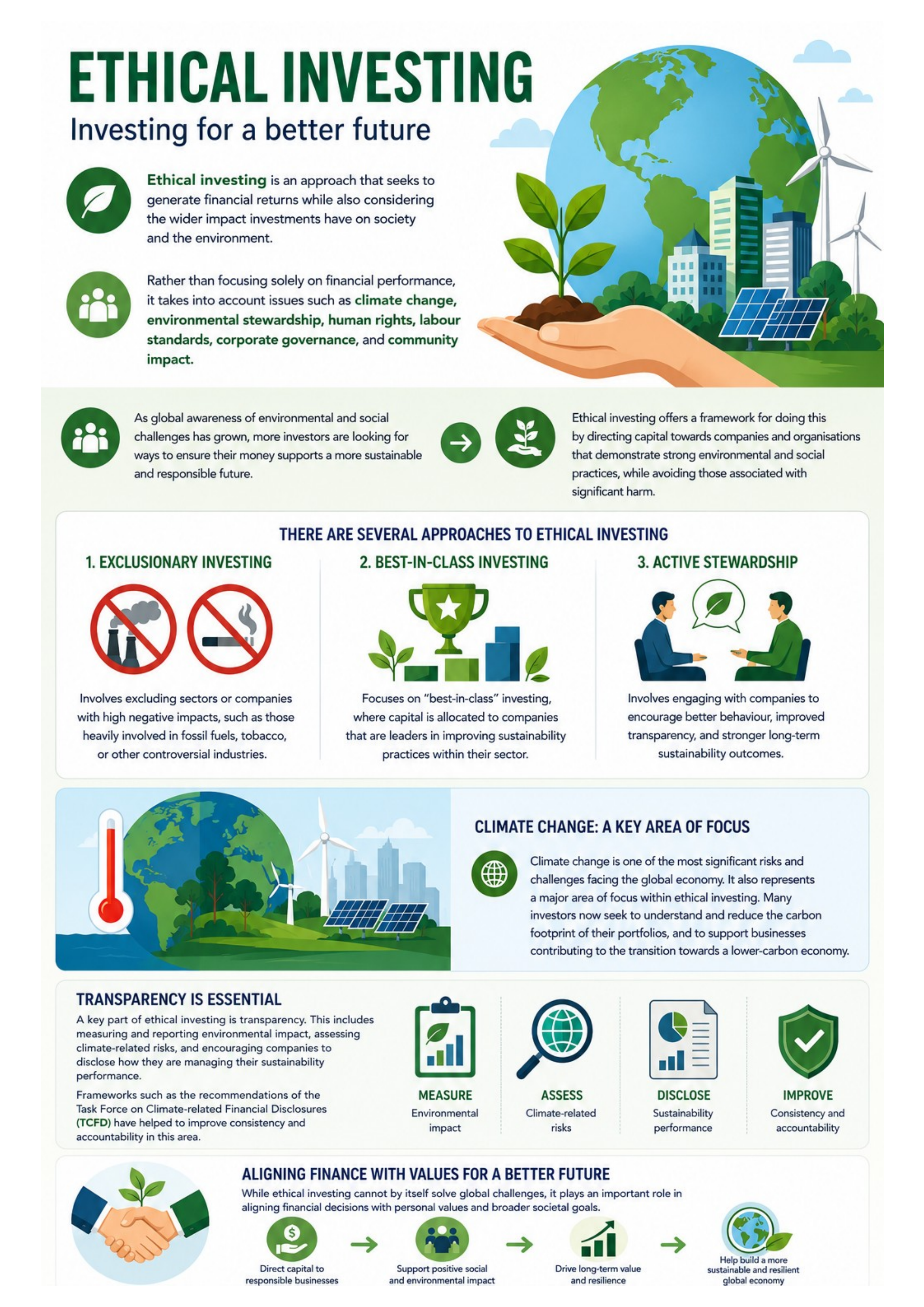
Ethical Investing - one-page guide

Ethical Investing - one-page summary sheet
Download the PDF

Carbon Offsetting

So, we have done everything we can to reduce our carbon footprint, increased our ethical influence, and we feel proud of that. But we feel there is more we should do.

"Carbon offsetting is one of the last things that we can consider. The easiest form of carbon offsetting is to pay someone to plant a tree for us. However, this is not going to be as effective in reducing our carbon footprint, as planting that tree ourselves. Furthermore, a tree planted today, is not going to have an immediate impact on reducing our carbon footprint for several decades to come. However, a tree will offer some benefit to wildlife as it grows, so it can be an interesting feature to monitor, especially if it is in our garden, or somewhere local that we can check on it."

"Other forms of carbon offsetting tend to be much larger projects that are not as personalised as planting a tree, such as investing in peatland restoration, renewable energy projects such as solar and wind for electricity generation and carbon capture and storage - although this really is a last resort attempt to address a problem that should have been stopped at the source."

Other Ethical Action

Purchases, donations, philanthropy - your money speaks.

Choose ethically sourced products - same values as ethical banking, applied to purchases.
Donate to charity - charitable status means values are baked in.
Consider philanthropy if you can - long-term giving with personal involvement in the cause.

Networking & Campaigning

Spread the word.

"If you believe in and are passionate about lowering your carbon footprint, enhancing nature and making the World a better place, tell people about A Ride For Life."

"If you are motivated to do so, start your own campaign. No matter how small your campaign is, tell family, friends, communities, folks in the pub, club, association. In fact, anyone, anywhere that will listen!"

"Every person that we educate and persuade to do something, will help to make a difference."

Remember Sir David Attenborough's words

"We can do it"

"It's within our power, to do it"

"We CAN do it"

"We MUST do it"

"THEN, THERE WILL BE A FUTURE FOR THE PLANET"

— Sir David Attenborough